Daily Weird News Report
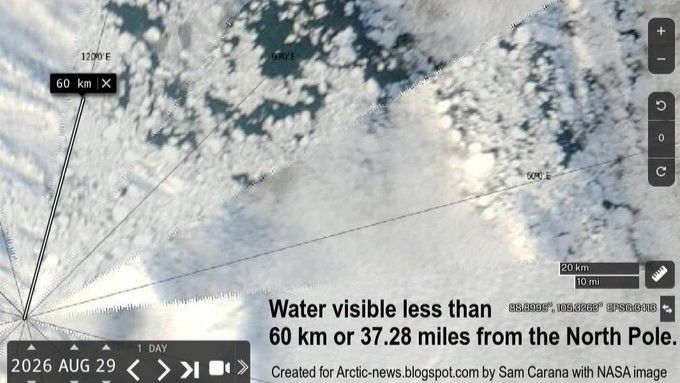
Large areas of open water appeared just 37 miles (60 kilometers) from the North Pole in a NASA satellite image taken Aug. 29, 2026, according to Live Science. The image was viewed through NASA’s Worldview satellite tool and later shared by the blog Arctic News.
The gaps are located within late-summer Arctic sea ice, which typically becomes more broken up toward the end of the season. Zachary Labe, a climate scientist at Climate Central, told Live Science that local weather and ocean currents can cause the openings between ice floes to expand or close over periods ranging from hours to days. Strong winds may push fragments together or pull them apart.
Julienne Stroeve, a professor of polar observation and modeling at University College London, described the extent of the visible water as striking. She noted that open water can sometimes be seen near the North Pole, while adding that she did not think she had previously seen it spread this widely.
The image alone does not establish that Arctic sea-ice conditions are worse in 2026 than in every recent year. Live Science reported that the current ice extent was not especially low compared with record-setting years, although the fragmented nature of the ice makes conditions highly changeable. Winds could compress the ice and produce sudden changes in its measured extent.
There is no fixed boundary where open water should normally end near the pole, because Arctic conditions vary from year to year. However, Labe said summer ice has become thinner and more fragile in recent years, allowing open water to reach closer to the North Pole more consistently than it did in the past.
The broader changes may affect local weather, ocean conditions and marine ecosystems, while increasing risks such as coastal erosion and flooding for Arctic communities, according to Labe. Scientists expect refreezing to begin around the middle to latter part of September, potentially closing at least some of the gaps.