Daily Weird News Report
A long-buried volcanic system beneath eastern England appears to have produced one of the largest eruptions known from its time, but experts caution against calling it a “supervolcano.”
The remains lie beneath parts of Norfolk and Lincolnshire, where erosion, burial and geological changes have obscured most of the original structure. Researchers spent about three decades piecing together its scale using zircon crystals collected 80 years ago from boreholes roughly 65 kilometers apart.
Zircon forms inside molten magma and contains uranium that gradually decays into lead isotopes. By dating the crystals, the scientists found that samples from eastern England matched zircon from the Kinnekulle tephra, a major layer of volcanic ash found across Scandinavia and the Baltic region.
The connection suggests that ash from the English eruption traveled across the Tornquist Sea, which existed during the Ordovician period, between about 488.3 million and 443.7 million years ago. The analysis also identified evidence of an earlier eruption, dated to approximately 453.7 million years ago.
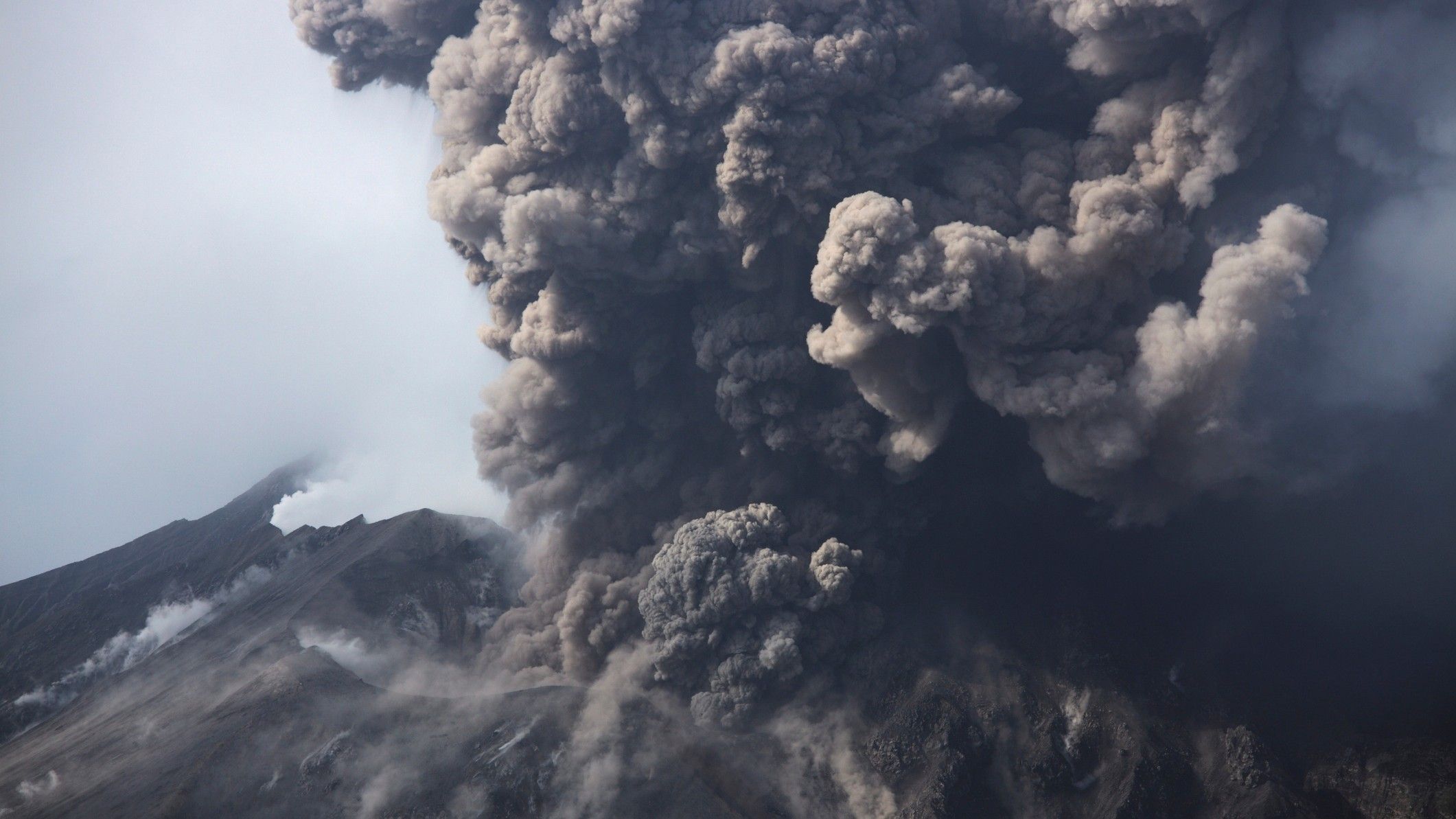
The eruption likely generated enormous pyroclastic flows—fast-moving mixtures of hot gas, ash and rock—and may have sent ash clouds more than 40 kilometers high into the stratosphere. Researchers said the event could have lasted from days to weeks. However, little of the erupted material remains, making its original volume difficult to calculate.
Michael Poland of the Cascades Volcano Observatory and Yellowstone Volcano Observatory, who was not involved in the research, said the deposits were too poorly preserved to determine the eruption’s volume reliably. Peter Rowley, a volcanologist at the University of Bristol, likewise said that “supervolcano” is an imprecise term and described the event instead as an ultraplinian eruption, a category generally associated with the most violent volcanic explosions.
Stephen Self of the University of California, Berkeley, also said the term has become a buzzword. Geologists more commonly classify eruptions by the amount of material they eject, rather than by the size of the volcano itself.
The ancient system was part of a broader volcanic region that also included areas now represented by Eryri National Park in Wales and England’s Lake District. What remains today is largely evidence of eruptions and underground magma reservoirs—not a preserved volcano rising beneath the modern landscape.