
Daily Weird News Report
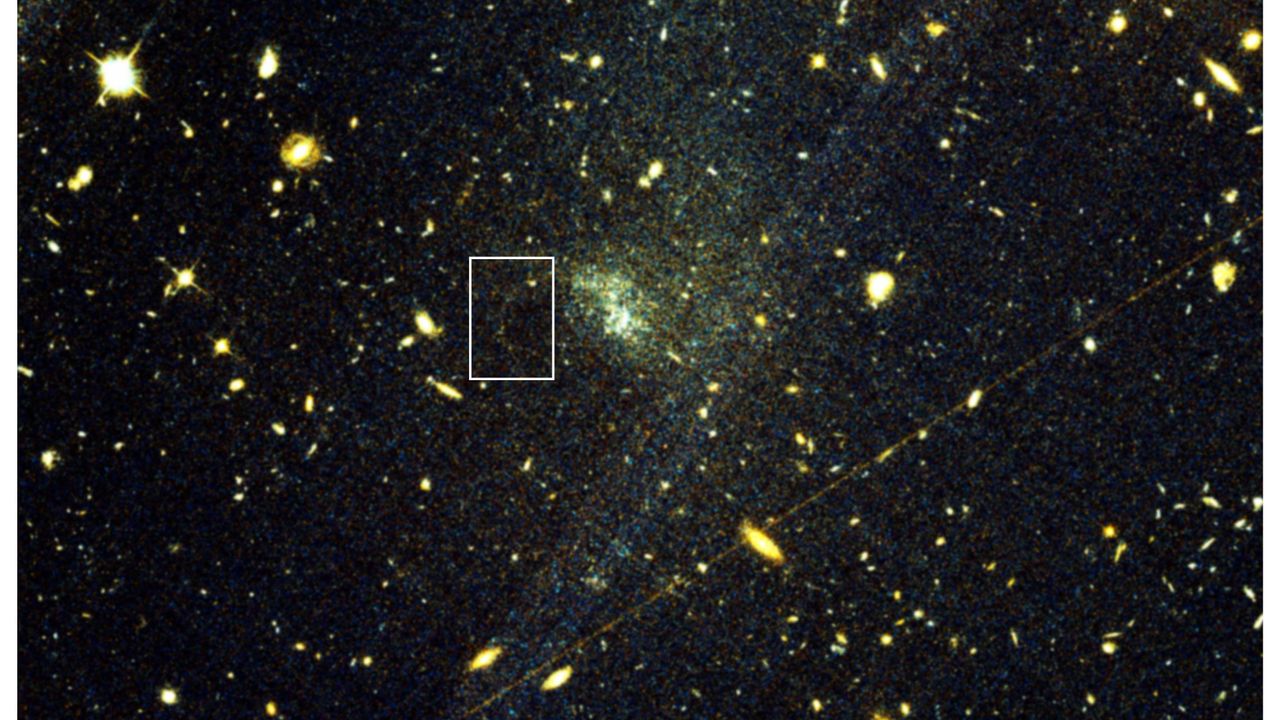
A faint ribbon hidden in an old Hubble Space Telescope image has led astronomers to what researchers say is the first known stellar stream from a globular cluster outside the Milky Way.
The feature, later named Oyashio, appears near UGC 9050-Dw1, an ultra-diffuse dwarf galaxy about 115 million light-years from Earth. Its discovery began in June 2023, when former astronomer David Hendel noticed the barely visible arc while reading an astronomy paper on a morning train in New York City.
Hendel recognized several details that suggested the arc was not simply a random arrangement of stars: the stars appeared to share a color, followed a curved path, and seemed to lead toward a compact bright object that could be the stream’s globular-cluster source. He sent an image and sketch of the feature to Sarah Pearson of the Technical University of Denmark, beginning a collaboration with Pearson and Julie Kiel Holm of the University of Copenhagen.
The researchers examined archival observations from both Hubble and the Canada-France-Hawaii Telescope. According to the team, the feature was present in both datasets, making a telescope or image-processing artifact less likely. Thousands of simulations were then used to test combinations of cluster properties and dark-matter distributions that could produce the stream’s observed shape and brightness.
The best-fitting models suggested that UGC 9050-Dw1 contains substantially more dark matter than its sparse population of visible stars might indicate. The stream could therefore provide a useful record of the gravitational environment around the galaxy.
Stellar streams form when gravity pulls stars from a globular cluster over long periods. If a small concentration of dark matter, known as a subhalo, passes through such a stream, it could disturb the stars and create a gap. Researchers say a stream outside the Milky Way may be especially valuable because it is not subject to some of the competing gravitational influences found in our own galaxy, such as its central bar and nearby dwarf galaxies.
The team considered other possibilities, including a chance alignment, gravitational lensing, or a dusty region mimicking the stream. The researchers said those explanations did not account for all the observed features, while also acknowledging that they cannot completely eliminate every alternative.
The discovery was reported in a paper published Aug. 12 in Nature. Future observations from facilities including the Vera Rubin Observatory, the Nancy Grace Roman Space Telescope and the Euclid mission could reveal more such streams, allowing astronomers to compare them across different galaxies and better isolate possible dark-matter effects.


