Daily Weird News Report
A limestone monument portraying one of the Maya world’s most powerful women has survived in more than 40 fragments—and still weighs roughly 2,500 pounds.
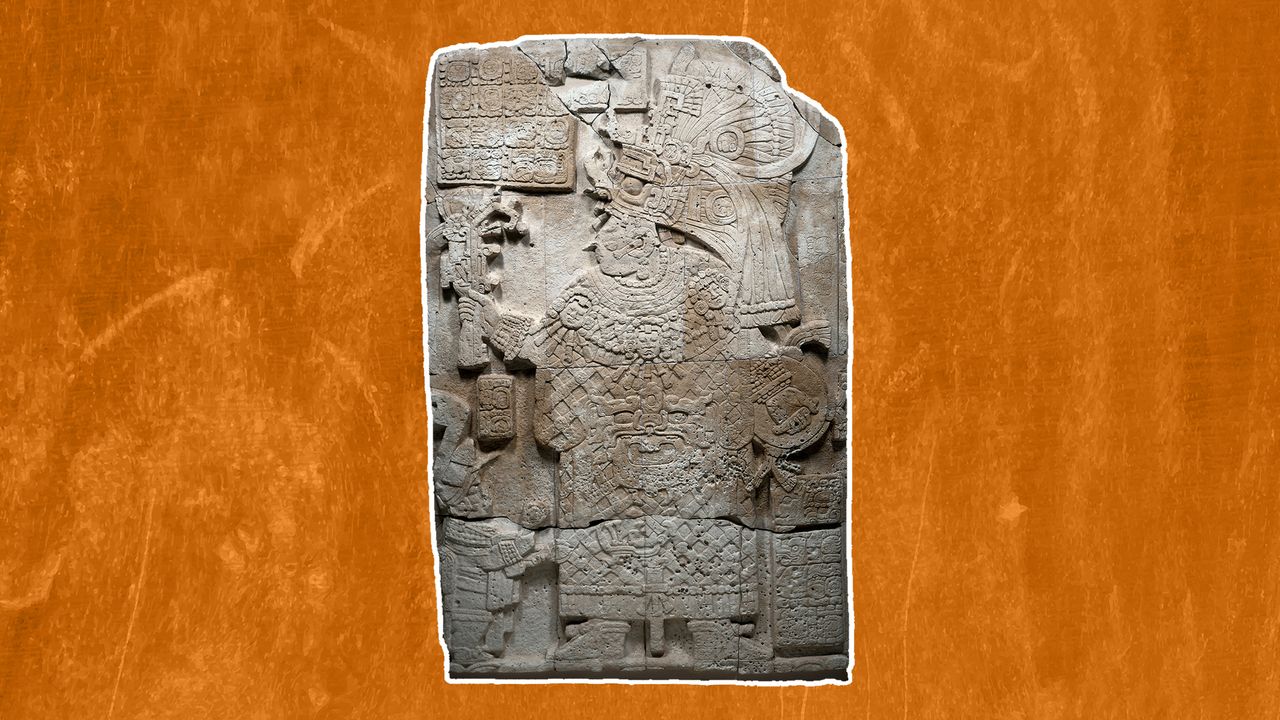
According to Live Science, the carved stone slab depicts Lady K'abel, also known as Water Lily Hand and Divine Woman of the Snake Polity. It was likely erected in A.D. 692 at El Perú-Waka', a Maya settlement in Guatemala’s Petén region, to commemorate the end of a k'atun, a 20-year period in the Maya calendar.
The reconstructed front section is about 9 feet tall and is now part of the Cleveland Museum of Art’s collection. It is only the front face of what was originally a freestanding monument. A similar stela once stood nearby, portraying Lady K'abel’s husband, K'inich Bahlam II, who was described as holding a lower rank.
Lady K'abel belonged to the Kaanul, or Snake, dynasty and ruled El Perú-Waka' as a military governor, according to the museum. The monument gives her the title Ix Kaloomte', meaning “Lady Supreme Warlord.” Experts cited by Live Science think she may have led an army from Calakmul against Tikal, although the report presents that as a possibility rather than an established fact.
The carving presents its subject in elaborate ceremonial clothing. A headdress spreads into a fan of green quetzal feathers, while jade beads form her necklace and netted garment. She carries a scepter and a circular shield, objects associated with her military title. A small figure with dwarfism appears in the lower-left portion of the carving and may have been an attendant or courtier.
Her costume also connects her with a Maya supernatural figure, identified by experts as either the maize god or the moon goddess. Archaeologist Phil Wanyerka interpreted the imagery as linking Lady K'abel with creation, renewal and rebirth at the transition between calendar periods.
The stela’s connection to the queen became stronger decades after the museum acquired it in 1967. In 2012, archaeologists excavating at El Perú-Waka' found a royal tomb near the monument. The burial included jade, obsidian and shell artifacts, including a bivalve shell positioned on the skeleton’s pelvis that matched one shown on the stela. A small alabaster object bearing hieroglyphs named Lady K'abel as its owner, providing evidence that the tomb’s occupant was the ruler depicted on the imposing stone.