
Daily Weird News Report
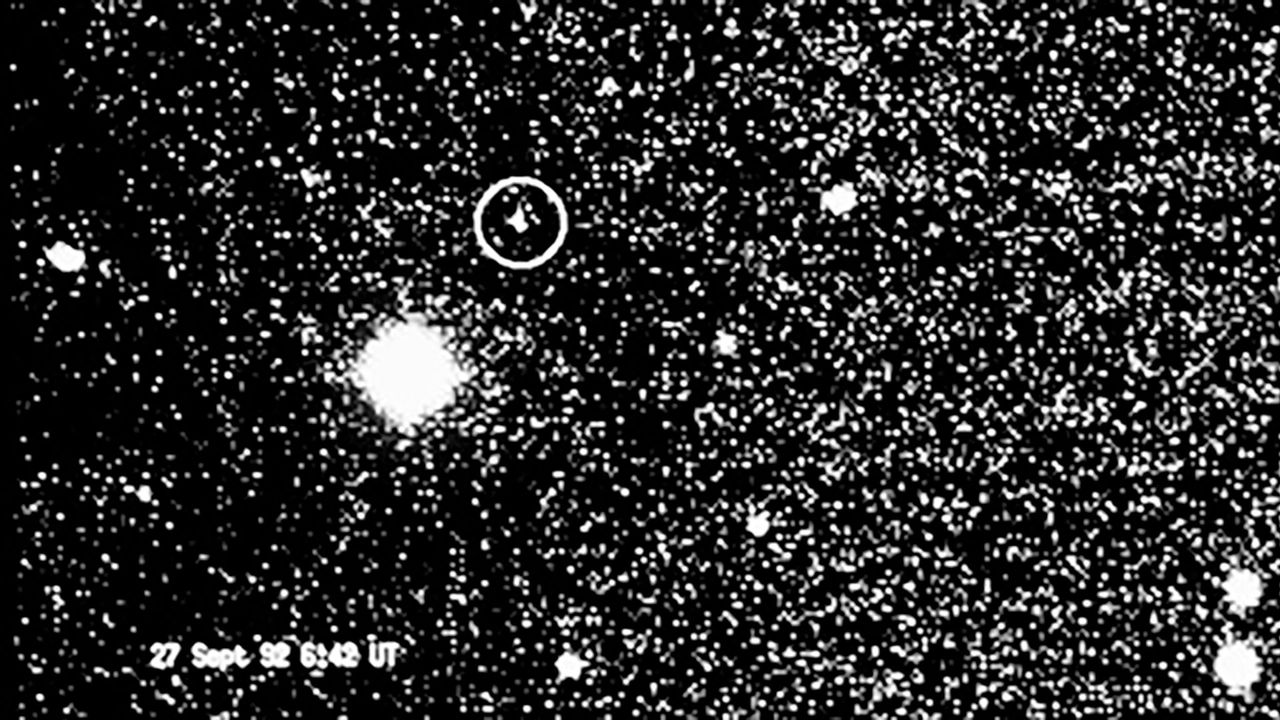
For much of the 20th century, Pluto appeared to mark the outer edge of the solar system. That changed on Aug. 30, 1992, when astronomers detected a small object orbiting the sun beyond Neptune and Pluto.
The object, officially designated 1992 QB1, was the first confirmed Kuiper Belt object. Space.com reports that it is about 100 miles (160 kilometers) wide and was thousands of times fainter than Pluto, making it invisible to earlier observing technology. Digital imaging techniques allowed astronomers to identify it as a tiny world roughly 4 billion miles beyond Neptune.
The discovery provided the first direct evidence of the distant region that had been proposed by Dutch astronomer Gerard Kuiper. The Kuiper Belt begins near Neptune’s orbit and extends far into the outer solar system in a broad, doughnut-shaped zone. It is now known to contain more than 2,000 objects.
Pluto itself had been discovered in 1930 and was initially classified as a planet. But the identification of 1992 QB1 opened the way for further discoveries, including objects larger than Pluto. The later discovery of Eris, which is larger than Pluto, contributed to the decision in 2006 to classify Pluto as a dwarf planet.
The Kuiper Belt has since become more than a collection of distant points of light. NASA’s New Horizons spacecraft flew past Pluto in 2015, becoming the first spacecraft to do so, and later encountered the Kuiper Belt object Arrokoth on Jan. 1, 2019.
What began as the detection of one extremely faint object changed the perceived scale of the solar system. Pluto was no longer its apparent endpoint, but one member of a much larger population of bodies orbiting in the cold darkness beyond Neptune.