Daily Weird News Report
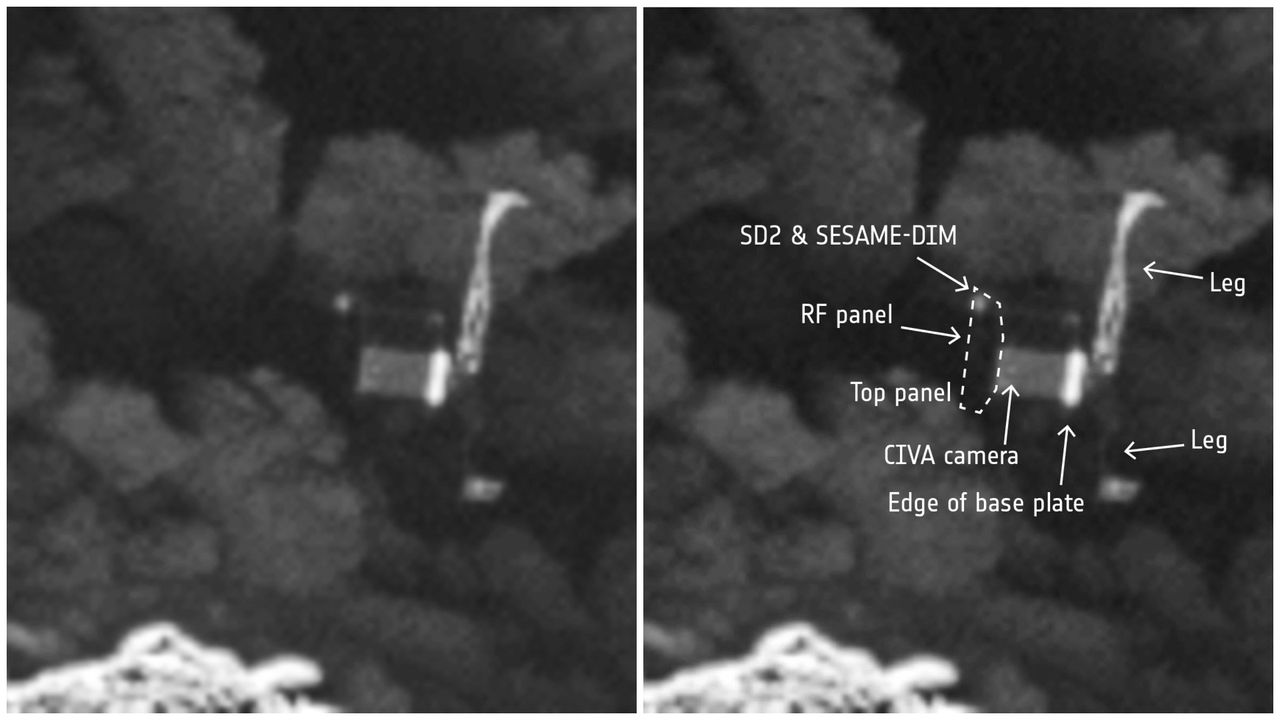
For nearly two years, the European Space Agency searched for a small spacecraft that had disappeared on the surface of a comet. On Sept. 2, 2016, Rosetta finally found it.
The missing vehicle was Philae, a washing-machine-sized lander released by Rosetta onto Comet 67P/Churyumov-Gerasimenko in November 2014. Its landing harpoons failed to anchor it, causing Philae to bounce across the comet before coming to rest in a shaded, rocky crevice.
A photograph taken by Rosetta showed Philae lying on its side. The position explained why the lander had been difficult to locate and why its mission was cut short: its solar panels received too little sunlight to provide sustained power.
Philae transmitted data using its onboard batteries after landing, and it made occasional contact with Rosetta during the following months. However, its batteries ran out after about 60 hours. Despite the limited operating time, the lander carried 10 scientific instruments, including a drill, and detected organic material on the comet, according to mission scientists cited by Space.com.
Finding Philae was the result of an extended search by Rosetta, which continued orbiting Comet 67P and photographing its surface. The spacecraft took more than 80,000 images while studying the comet and looking for the lander.
Philae’s landing had been a major moment in space exploration. Although the probe bounced twice and landed three times, it ultimately achieved the first soft landing on a comet. NASA’s Deep Impact mission had previously collided with a comet in 2005, but it was not designed to make a controlled landing.
The discovery came only weeks before Rosetta’s own mission ended with the spacecraft landing on Comet 67P. Locating Philae gave the European Space Agency a final view of the lander and brought an end to one of the mission’s longest searches.