
Daily Weird News Report
Physicists at CERN have recreated a brief, microscopic state of matter associated with the early Universe by smashing relatively small atomic nuclei together at nearly the speed of light.
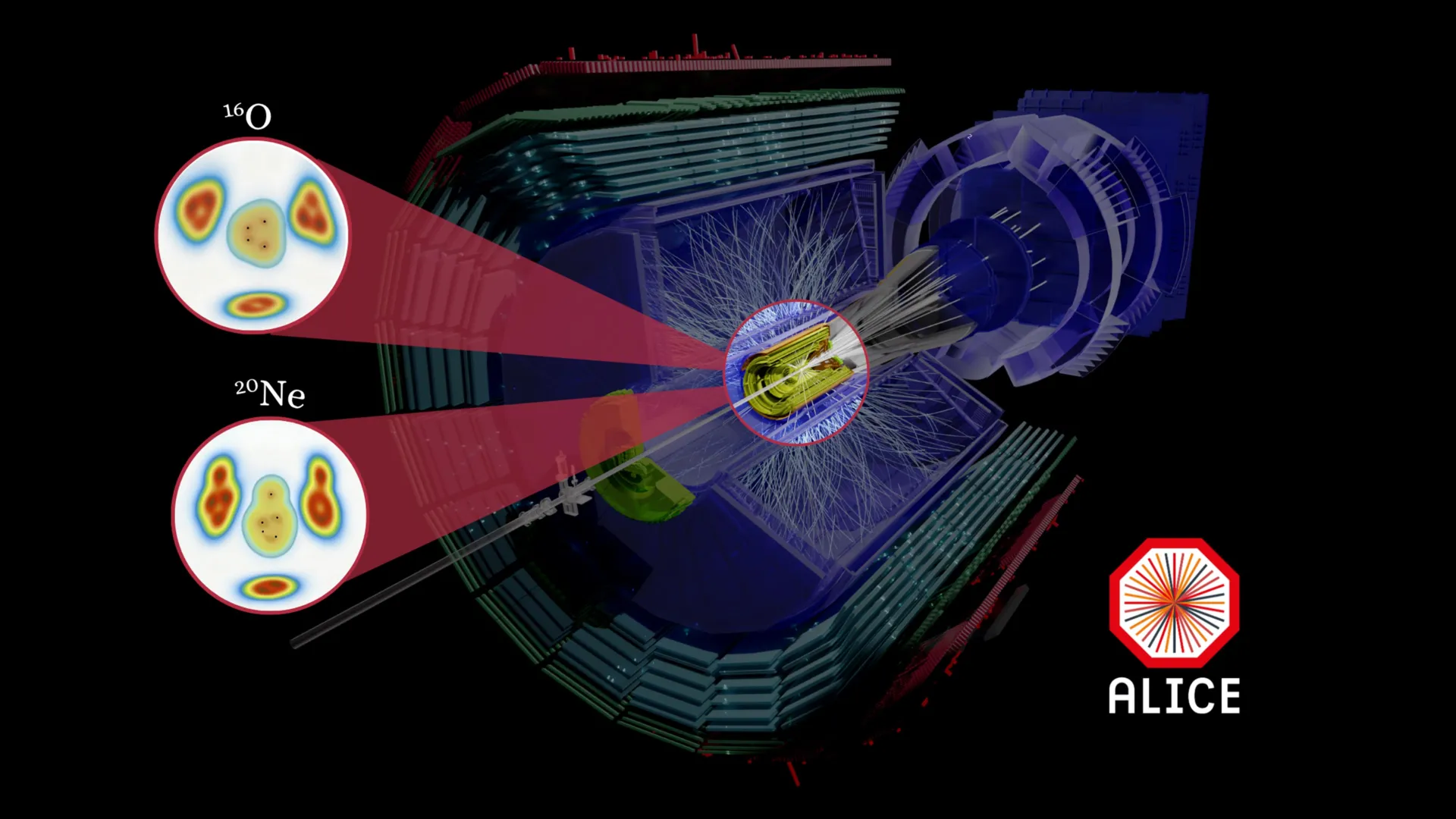
The experiments, conducted by researchers from the University of Copenhagen and the international ALICE collaboration, used collisions involving oxygen-16 and neon-20 nuclei. The collisions produced quark-gluon plasma, an extremely hot and dense form of matter believed to have filled the Universe during its first millionth of a second, before protons and neutrons had formed.
Scientists had traditionally expected that producing this primordial material would require collisions between much heavier nuclei, such as lead. The new findings indicate that the collision system can be smaller than previously thought while still creating the plasma. Researchers describe the events as a kind of “Little Big Bang,” referring to the conditions produced in the laboratory rather than suggesting that a new universe was created.
The plasma itself existed for only an extremely short time and could not be observed directly. Instead, the researchers examined the particles produced as the tiny droplet expanded and broke apart. According to the study, the movement patterns of those particles retained information about the geometry of the original nuclei.
Collisions involving two oxygen nuclei produced a comparatively rounded pattern. Neon nuclei, by contrast, generated a pattern associated with a more elongated, bowling-pin-like shape. Researchers say this provides a way to investigate nuclear structure through the aftermath of high-energy collisions rather than only through lower-energy measurements of how nuclei rotate or vibrate.
Nuclear shape reflects how protons and neutrons are arranged and may provide information about the strong force, one of nature’s fundamental forces. The team says the approach could eventually help examine nuclei whose internal structures are not well understood, although further development is needed.
The researchers also say the smallest possible collision system capable of producing quark-gluon plasma remains unknown. Future experiments are planned with even lighter nuclei, including helium-4. The findings were published in Physical Review Letters.