
Daily Weird News Report
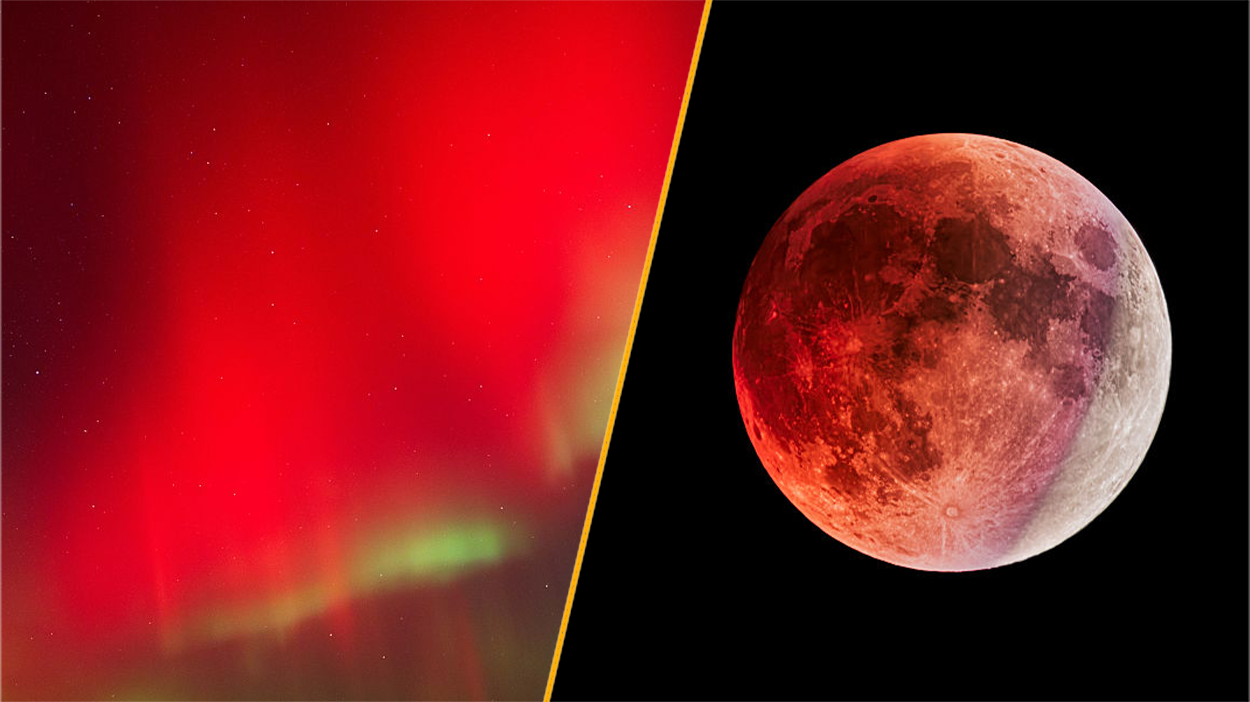
Skywatchers may have an unusual double spectacle on the night of Aug. 27-28, when a partial lunar eclipse is expected to occur as geomagnetic storm conditions could bring northern lights to parts of North America.
The eclipse will carry the moon into Earth’s shadow, covering about 96% of its surface and giving the visible portion a coppery-red appearance. It is expected to begin at 9:23 p.m. EDT, reach its deepest point shortly after midnight and finish at about 3 a.m. EDT on Aug. 28.
Because the moon will not be completely covered, it is not technically a total lunar eclipse or an official “blood moon.” However, Live Science reported that it will be the deepest lunar eclipse visible anywhere in the world until the next total lunar eclipse, scheduled for Dec. 31, 2028.
The National Oceanic and Atmospheric Administration has issued a moderate G2 geomagnetic storm warning for 9:03 p.m. EDT on Aug. 27, shortly before the eclipse begins. NOAA expects auroras could be visible across an area extending from New York to Idaho, although observers farther north are more likely to see the eclipse and northern lights at the same time.
Astronomer Tom Kerss told Live Science that Canada and Alaska offer the strongest viewing prospects. The moon and aurora would probably appear in different parts of the sky, but viewing conditions farther west could allow the moon, low in the eastern sky, to overlap visually with the brightest part of the auroral oval.
The storm watch follows an M-class solar flare from sunspot 4513 on Aug. 25 and a subsequent coronal mass ejection. The cloud of solar plasma is expected to reach Earth between Aug. 27 and 28, with NOAA forecasting G1 and G2 storm conditions from 5 p.m. to 11 p.m. EDT on Aug. 27.
Most northern lights appear green when oxygen glows at lower altitudes. During stronger geomagnetic storms, auroras can reach oxygen higher than about 120 miles, where the gas produces red light. Kerss said that if such high-altitude red auroras occur over the horizon, they could appear alongside the moon’s own reddish glow.


