
Daily Weird News Report
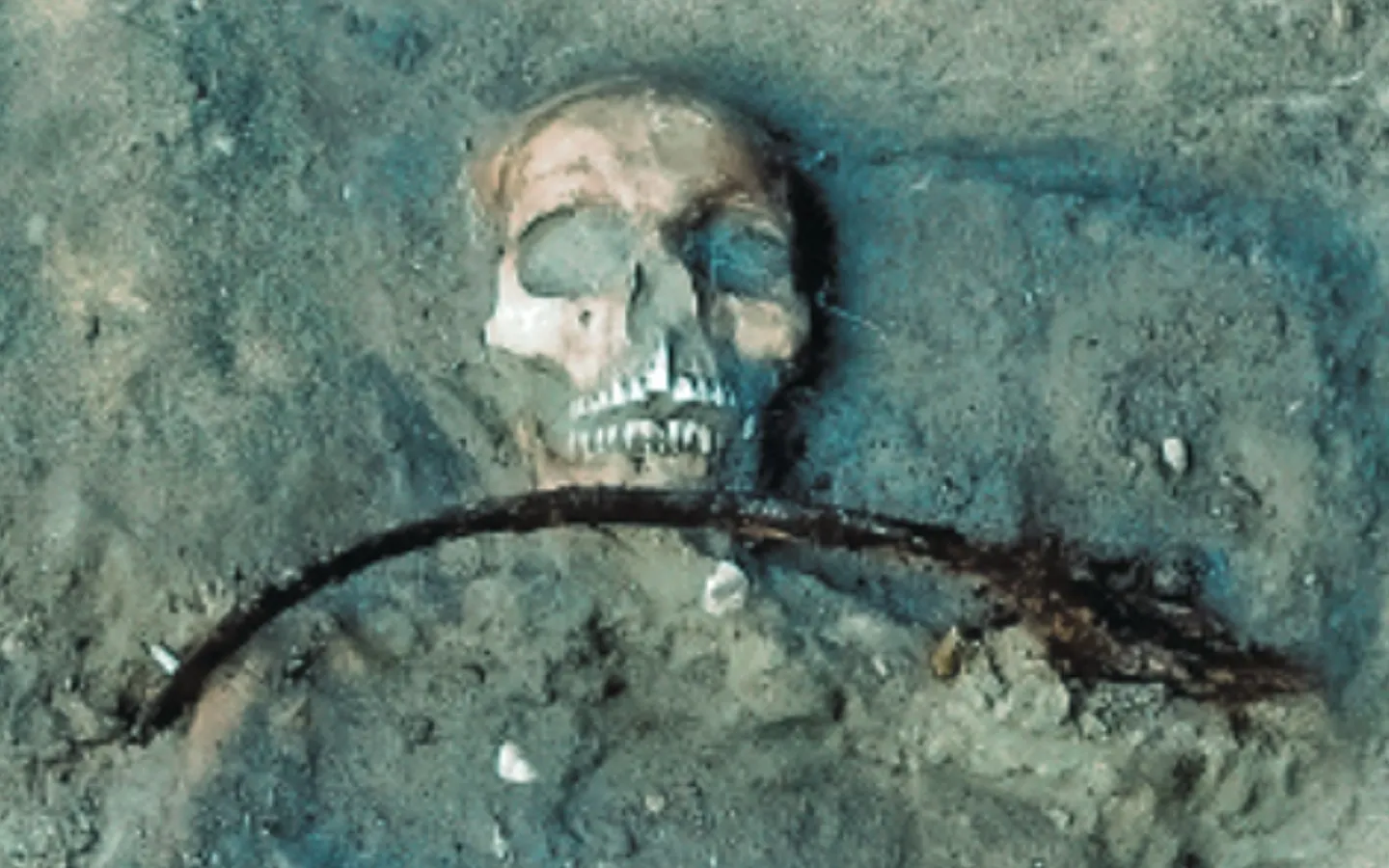
A young woman buried in 17th-century Poland was treated as someone who might return from the grave. Her remains were found with a 36-centimeter sickle positioned across her throat and a triangular padlock attached to the big toe.
The woman, discovered in Grave 75 at a cemetery in Pień, north-central Poland, was recovered by researchers from Nicolaus Copernicus University in 2022. Locals nicknamed her Zosia, while the unusual burial led to the more dramatic label “the Vampire of Pień.” A new study in the Journal of Archaeological Science: Reports examines the remains and objects found with them.
Researchers estimate that Zosia was between 17 and 19 years old when she died. DNA and isotope analysis indicates that she was local to the area but had Scandinavian ancestry. The team also examined the chemical properties of the metal objects and a fragment of woven decoration made from gold and silver threads and silk.
That decorative band, known as a galloon or galon, may once have trimmed a cap or another garment. The researchers say it could indicate that Zosia held a relatively elevated social position. Evidence from her bones also points to a diet containing slightly more animal protein than average.
The cemetery itself is absent from modern maps and historical records. Its lack of religious objects has led researchers to consider whether it may have served as a burial ground for people regarded as outsiders, including vagrants, heretics, orphans, unbaptized infants and people who died by suicide. However, the study does not establish why Zosia was buried there or why unusual precautions were taken with her body.
The cause of her death is also unresolved. Earlier speculation connected her to a condition that might have caused severe headaches and fainting, but researchers found no obvious evidence of trauma.
The sickle and padlock are interpreted as anti-vampiric measures: symbolic restraints intended to prevent the dead from returning or interacting with the living. The findings offer clues about Zosia’s identity and treatment after death, but they do not explain what led her community to regard her burial as requiring such protection.
/https://tf-cmsv2-smithsonianmag-media.s3.amazonaws.com/filer_public/72/23/72237884-a408-4fa1-9d75-fb7e3180300b/screenshot_2026-08-31_at_100523am.jpeg)

/https://tf-cmsv2-smithsonianmag-media.s3.amazonaws.com/filer_public/ce/3a/ce3ad4ec-2ba5-4000-badb-8ce3dc4cdf41/metal.png)