
Daily Weird News Report
Observations from the James Webb Space Telescope have identified black holes in the early universe that seemed to weigh hundreds of millions of times as much as the sun, despite appearing less than a billion years after the universe began. Their apparent size also seemed out of proportion to the small galaxies surrounding them.
New research discussed by Space.com suggests the discrepancy may result from how those black holes were measured. The study examined 14 early-universe black holes that were not detected in X-rays, including in deep observations by NASA’s Chandra X-ray Observatory. Alessandro Trinca of the Italian National Institute for Astrophysics and his colleagues treated the missing X-rays as evidence relevant to the mass estimates rather than simply as an observational gap.
According to the team’s analysis, the objects may have masses of roughly one million to 10 million solar masses. That is considerably below earlier estimates of tens or hundreds of millions of solar masses, placing them toward the less massive end of the supermassive black hole population. The revised figures are also more consistent with the properties of their host galaxies, the researchers said.
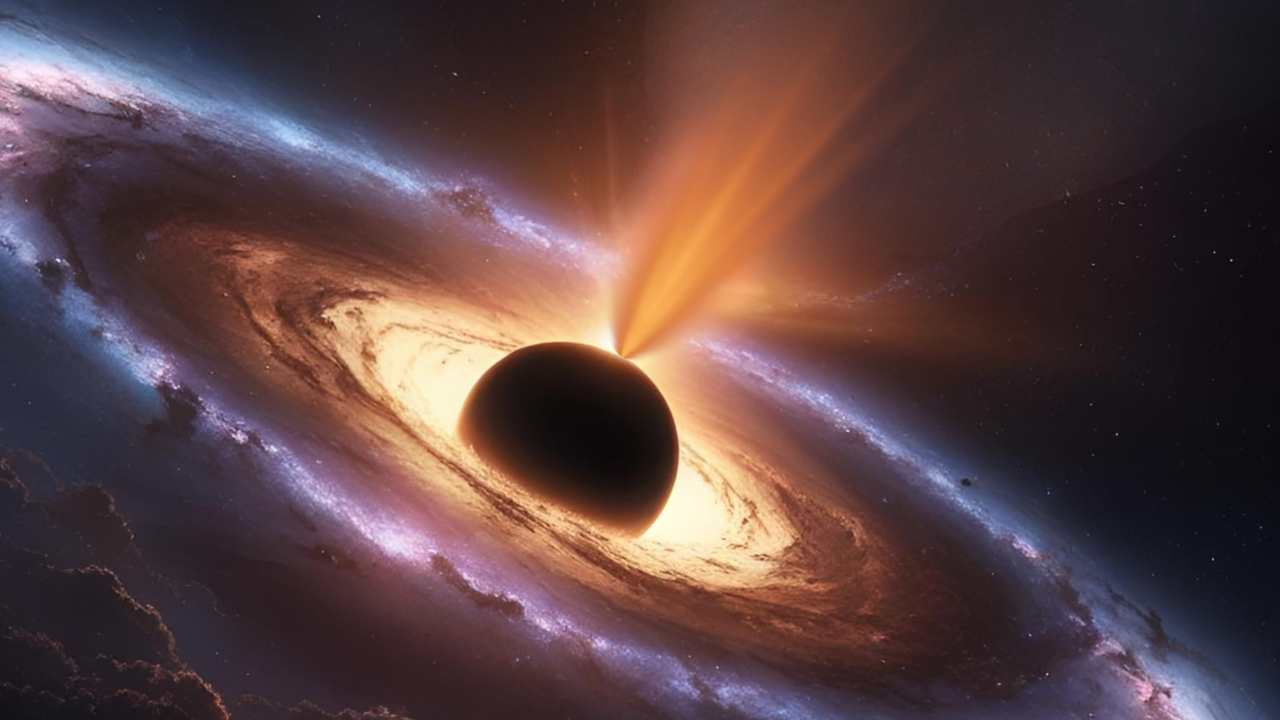
The proposed explanation involves extremely rapid accretion. When a black hole consumes matter at very high rates, the surrounding gas may form a thick, donut-like disk with a narrow opening along its rotation axis. In this model, X-rays produced near the black hole are scattered by the dense material and lose energy before escaping, leaving the object unusually faint in X-ray observations.
The researchers suggest these black holes may have undergone short periods of “super-Eddington” feeding—growth faster than the usual limit imposed by radiation from the accretion process. If the black holes were smaller than initially thought, they would have needed less matter to reach their observed masses, making brief bursts of intense growth sufficient rather than requiring uninterrupted feeding for hundreds of millions of years.
The idea remains to be tested. The team says deeper X-ray observations, improved spectra and independent measurements of black hole masses at increasingly early cosmic times could provide stronger evidence. The research was published in the June edition of Astronomy & Astrophysics.
/https://tf-cmsv2-smithsonianmag-media.s3.amazonaws.com/filer_public/4b/ad/4bad4ddf-a163-43bb-a53b-b04d0329f13c/new_dsc3177_copia.jpg)
