Daily Weird News Report
Some 3D-printed objects may soon be able to signal that something is wrong simply by changing their appearance.
Researchers at the Massachusetts Institute of Technology have developed ShiftLens, a design and fabrication system for creating 3D objects with mechanically switchable surfaces. The system uses no sensors, electronics, or batteries. Instead, it relies on an optical mechanism built into the object during a single multi-material 3D-printing process.
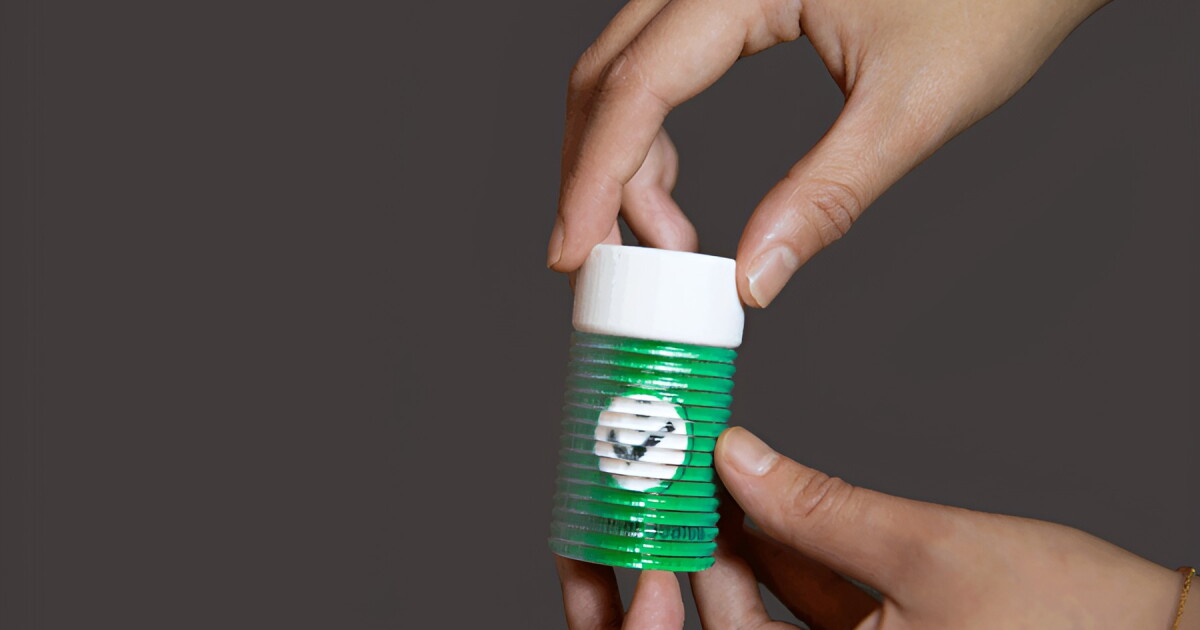
The mechanism combines a lenticular lens layer—made up of angled, transparent ridges—with a patterned image beneath it. When the object is rotated, pressed, or slid in a particular way, the lens shifts over the image and produces a different visible pattern or color.
That change can be used as a built-in status display. A pill bottle, for example, could show one appearance when it is properly closed and another when its cap has not been sealed correctly. The same basic approach could indicate an issue with a container holding a dangerous substance, a pipe, or another object whose condition needs to be checked.
Because the display is mechanical rather than electronic, the researchers say it would continue to function without a power source. The source material also describes it as potentially useful when an object becomes wet, is submerged, or has been loosened by movement or tampering.
The project was described in a paper by MIT electrical engineering and computer science graduate student Yunyi Zhu and co-authors from MIT, the Technical University of Munich, and Northeastern University. Zhu said the system is intended to let objects communicate whether they are being used correctly without requiring complicated electronics.
The team has also created a tool intended to let users design their own ShiftLens mechanisms by specifying features such as an object’s shape and curves. The tool is aimed at people including engineers, architects, artists, and product designers, although the source notes that some training may be needed.
Researchers plan to simplify the underlying algorithm so it requires fewer specifications and to expand the range of mechanisms the design tool can produce. For now, ShiftLens remains a research system showing how a printed object can provide visual feedback through movement alone.