Daily Weird News Report
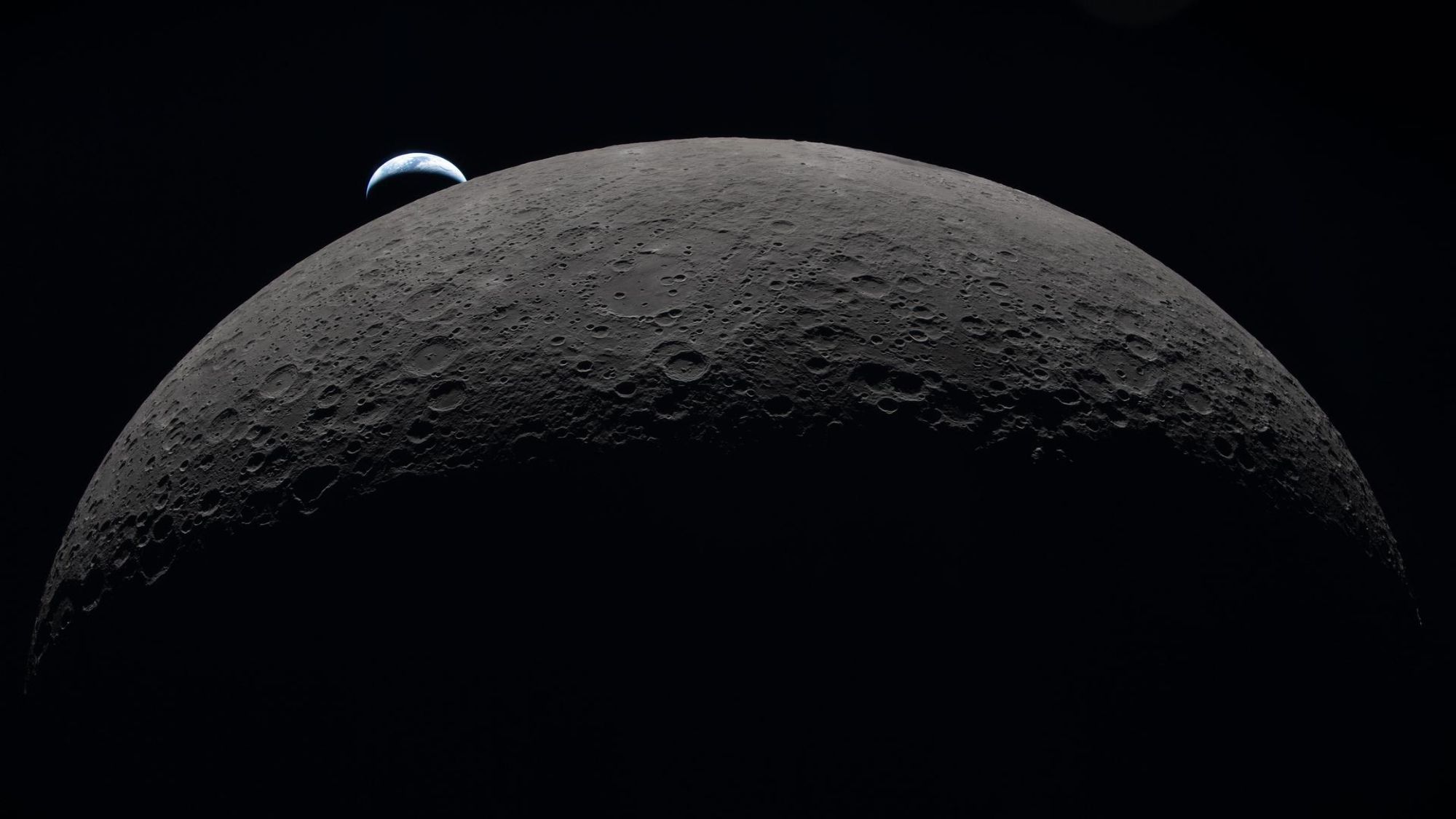
Earth’s moon may have formed far more quickly than previously assumed—possibly within about five hours of the collision that created it, according to new computer simulations reported by Space.com.
The leading explanation for the Moon’s origin involves a giant impact early in the solar system’s history. In this scenario, a Mars-sized protoplanet called Theia struck the young Earth, sending material into orbit. That debris eventually became the Moon.
The new simulations, led by Adeene Denton of the Southwest Research Institute, examined a factor that earlier models did not fully include: how the internal temperature of the colliding bodies affected their physical strength. Young planets remained hot after forming, and warmer rock is weaker than colder material.
That difference could have changed the outcome of the collision. A hotter Theia would have been more easily destroyed, producing a broad disk of debris around Earth. Under conditions matching the temperature structures used in earlier impact modeling, Denton’s team found that an intact Moon emerged from the debris in roughly five hours.
The simulations also produced a slower alternative. If Theia had collided with Earth later—around 100 million to 150 million years after the planets formed—it would have been cooler and stronger. In that case, more of Theia could have survived the impact, while debris gathered into the Moon gradually rather than almost immediately.
The rapid-formation scenario is consistent with NASA-led simulations published in 2022, which also indicated that the Moon could assemble within hours. However, the new modeling does not resolve every problem surrounding the impact theory. The simulations suggest that the Moon would consist mainly of material from Theia’s mantle, with a smaller contribution from Earth’s mantle. That result does not easily explain the close similarities between the Moon’s composition and Earth’s mantle, including unresolved differences in isotope levels.
Robin Canup, a planetary scientist who was not involved in the study, said the findings could link the Moon’s present physical properties—including possibly its volatile content—to the temperatures of Earth and Theia at the time of impact. That connection might help researchers estimate when the collision occurred.
The result could also affect the search for moons around planets outside the solar system. If impact-generated moons form in only a few hours, the disks that produce them may be too short-lived to observe around rocky exoplanets. The study was published Sept. 1 in The Astrophysical Journal Letters.