
Daily Weird News Report
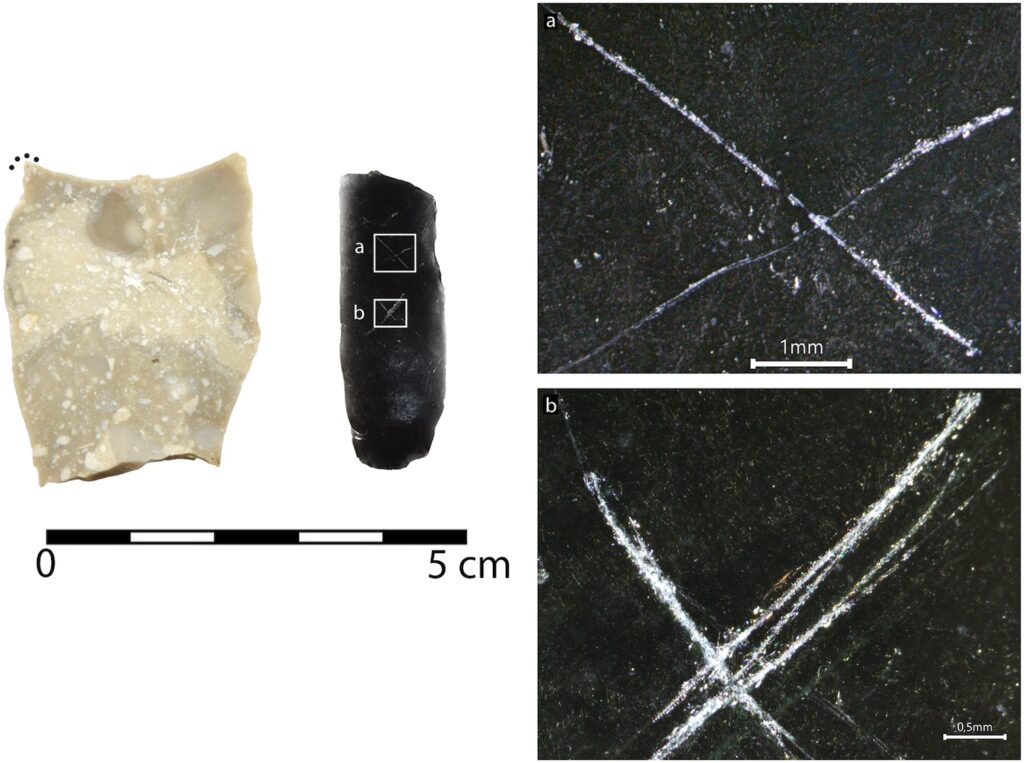
Eleven obsidian points discovered at the Neolithic village of Tepecik-Çiftlik in central Anatolia carry individually distinctive etched designs, according to Archaeology Magazine. The settlement lies between two major sources of volcanic glass, and thousands of obsidian arrowheads have been found in the surrounding region.
Only 54 of those thousands of points are known to bear markings. Alice Vinet of Aix Marseille University and Denis Guilbeau of France’s Ministry of Culture examined the etched examples under microscopes and tried to reproduce the incisions.
Their experiments indicated that making the marks required repeated strokes with a piece of flint. That finding makes accidental damage less likely, although it does not establish why the points were marked.
The researchers found no obvious physical distinction separating the etched points from the unmarked ones. Both groups had similar sizes and shapes, and the marked points showed wear comparable to that seen on points without designs. The incised objects also were not concentrated in special contexts such as graves.
A possible clue came from the designs themselves. Points found at the same sites sometimes carried similar motifs, suggesting that at least some markings may have followed recognizable patterns. However, the researchers concluded that the various markings may not all have served the same purpose.
The observations leave the function of the designs unresolved. Based on the reported study, the marks were deliberate, but the archaeological evidence does not indicate whether they identified objects, conveyed meaning, or served another role.

/https://tf-cmsv2-smithsonianmag-media.s3.amazonaws.com/filer_public/5e/8e/5e8ec5ec-bf1c-4f6c-b604-7e1ed6692863/island-archives-manuscript-21-of-25-1920x1280.jpg)