Daily Weird News Report
A NASA research aircraft took an unusual route to observe a total solar eclipse: it chased the Moon’s shadow from the sky above Iceland.
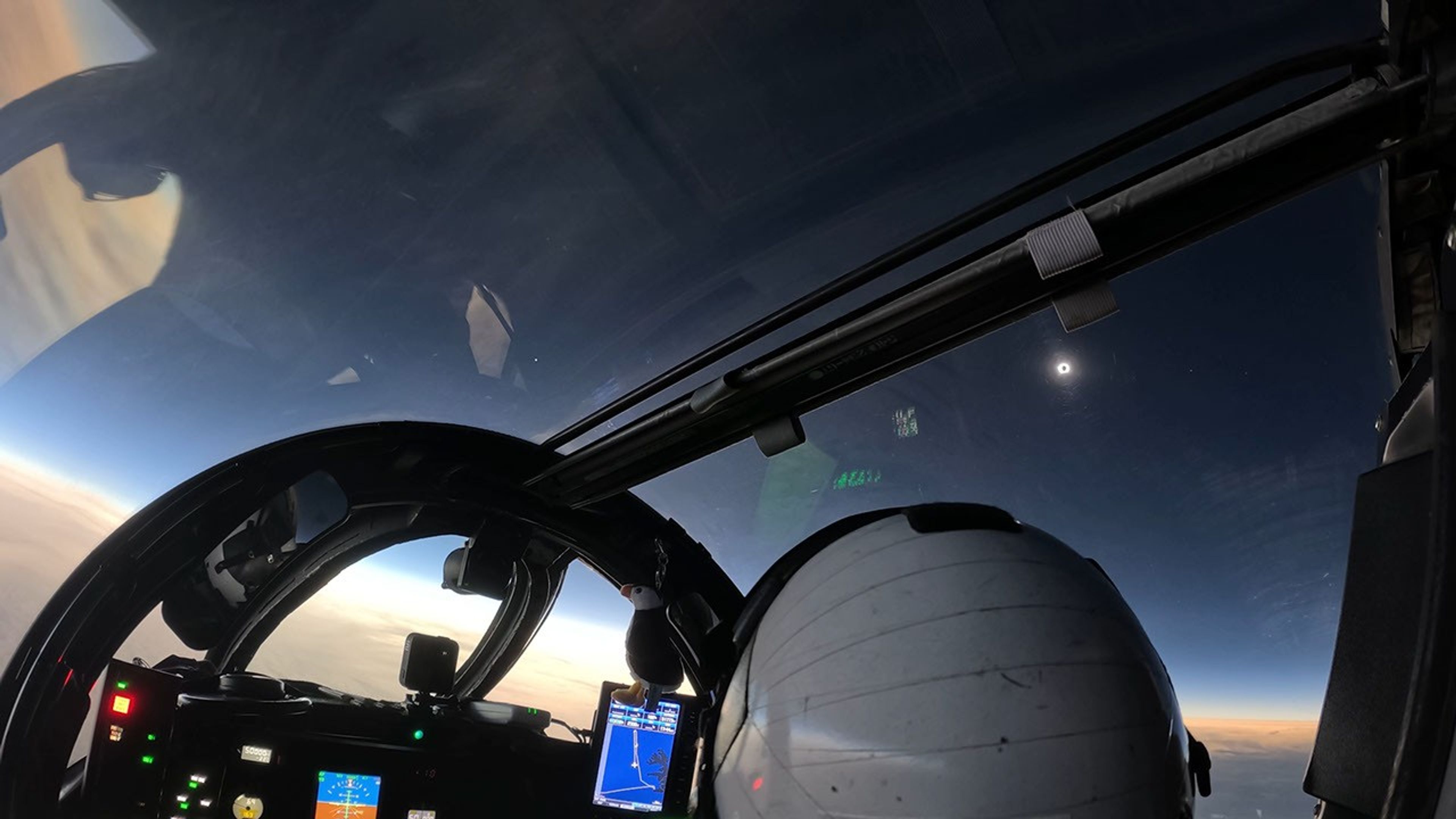
According to NASA’s Astronomy Picture of the Day entry for September 5, the WB-57F high-altitude research aircraft flew off Iceland’s coast on August 12, following a precisely calculated path of totality. The aircraft operated at an altitude of 50,000 feet, allowing it to remain in the Moon’s shadow for as long as possible.
A set of high-resolution cameras aboard the aircraft recorded data during the eclipse. NASA said the airborne observations took place above clouds, dust and atmospheric water vapor, all of which can interfere with eclipse viewing and scientific measurements closer to the ground.
The featured cockpit view came from an inflight video taken during the flight. It shows the solar corona appearing as totality began, while the sky around the eclipsed Sun darkened under the Moon’s shadow.
The scene also included several planets. Venus appeared to the left of the center of the video frame, while Jupiter and Mercury were visible near the right side of the eclipsed Sun. The distant horizon remained bright, however, because it lay beyond the reach of the Moon’s shadow.
NASA’s daily Astronomy Picture of the Day program features a different image or photograph of the universe each day, accompanied by an explanation written by a professional astronomer. The September 5 entry was credited to NASA, with Jerry Bonnell, Cecilia Chirenti, Robert Nemiroff and Keighley Rockcliffe listed among the authors and editors.
NASA also noted that the program’s main website is moving from apod.nasa.gov to science.nasa.gov/apod. The next featured image was scheduled to focus on Pluto.