Daily Weird News Report
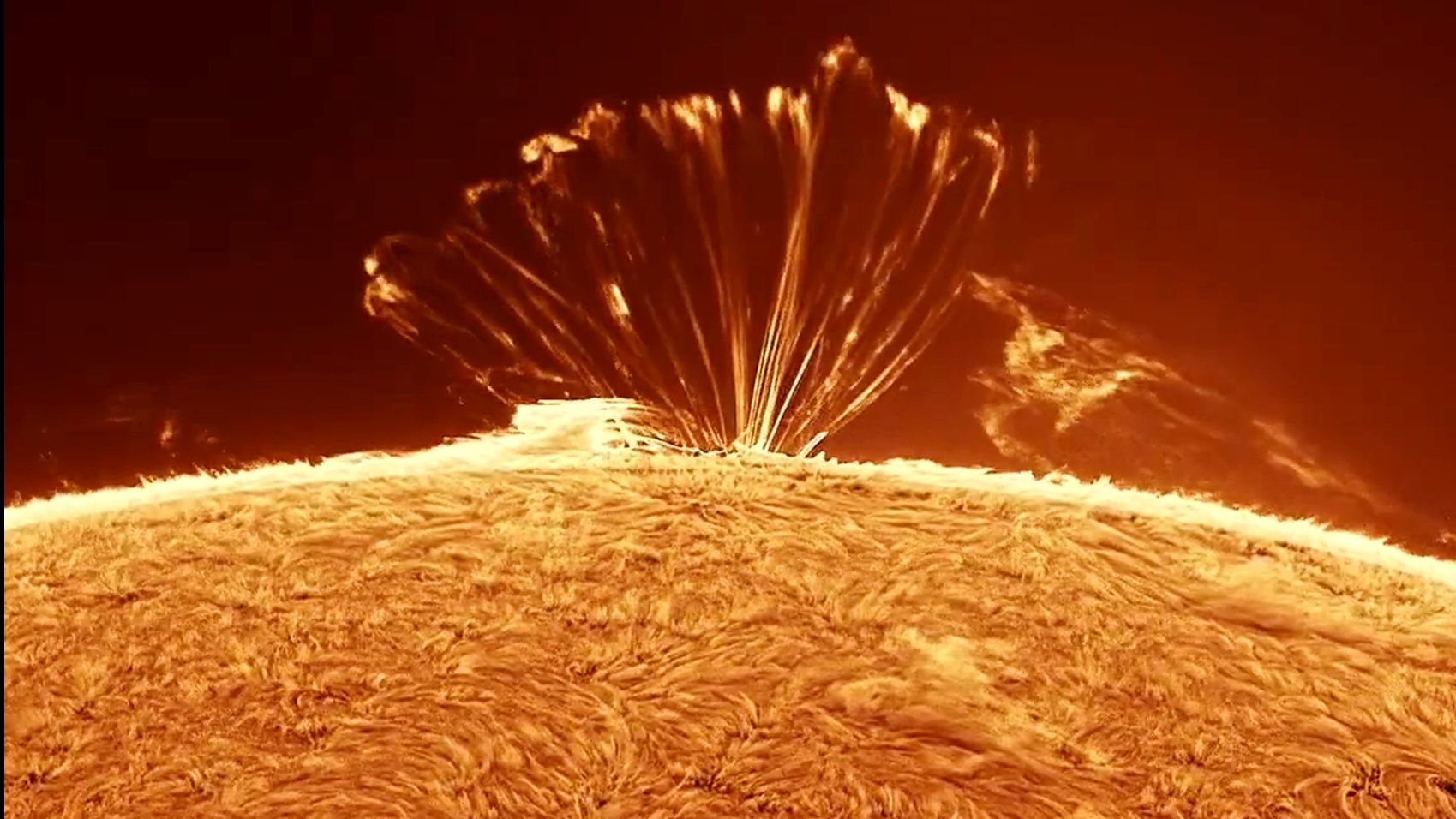
A series of bright plasma arches has been captured in remarkable detail by astrophotographer Mark Johnston, who recorded the Sun from his backyard in Scottsdale, Arizona, on Aug. 21, 2026.
The image featured by Space.com is a still from a high-resolution timelapse lasting more than two hours, from 7:56 a.m. to 10:12 a.m. local time. It shows a coronal loop arcade: multiple loops of hot plasma extending above the Sun’s apparent edge, known as the solar limb.
The loops are shaped by the Sun’s magnetic field. Johnston’s footage also reveals plasma moving through the structures, including what is known as “coronal rain.” In this process, material cools and falls back toward the lower solar atmosphere along magnetic field lines.
Johnston used a TEC160FL refractor fitted with specialized hydrogen-alpha solar imaging equipment. The setup makes it possible to reveal solar-atmosphere features that would otherwise be difficult to see.
According to Space.com, the viewing angle made the sequence especially striking. The loop arcade appeared almost side-on at the Sun’s edge, emphasizing the arches’ structure. Johnston told the outlet that capturing the formation at the limb, on a clear day when he was available, was a particularly fortunate combination.
Johnston said he checks real-time imagery from NASA’s Solar Dynamics Observatory each morning. After seeing the solar feature in the imagery one day, he quickly set up his equipment to record it.
This was not his first notable solar observation from home. Space.com reported that in June he also photographed a large plasma cloud near the Sun’s edge, accompanied by streams of coronal rain returning toward the solar surface.