Daily Weird News Report
Saturn has developed a new polar pattern—and this one has 10 sides.
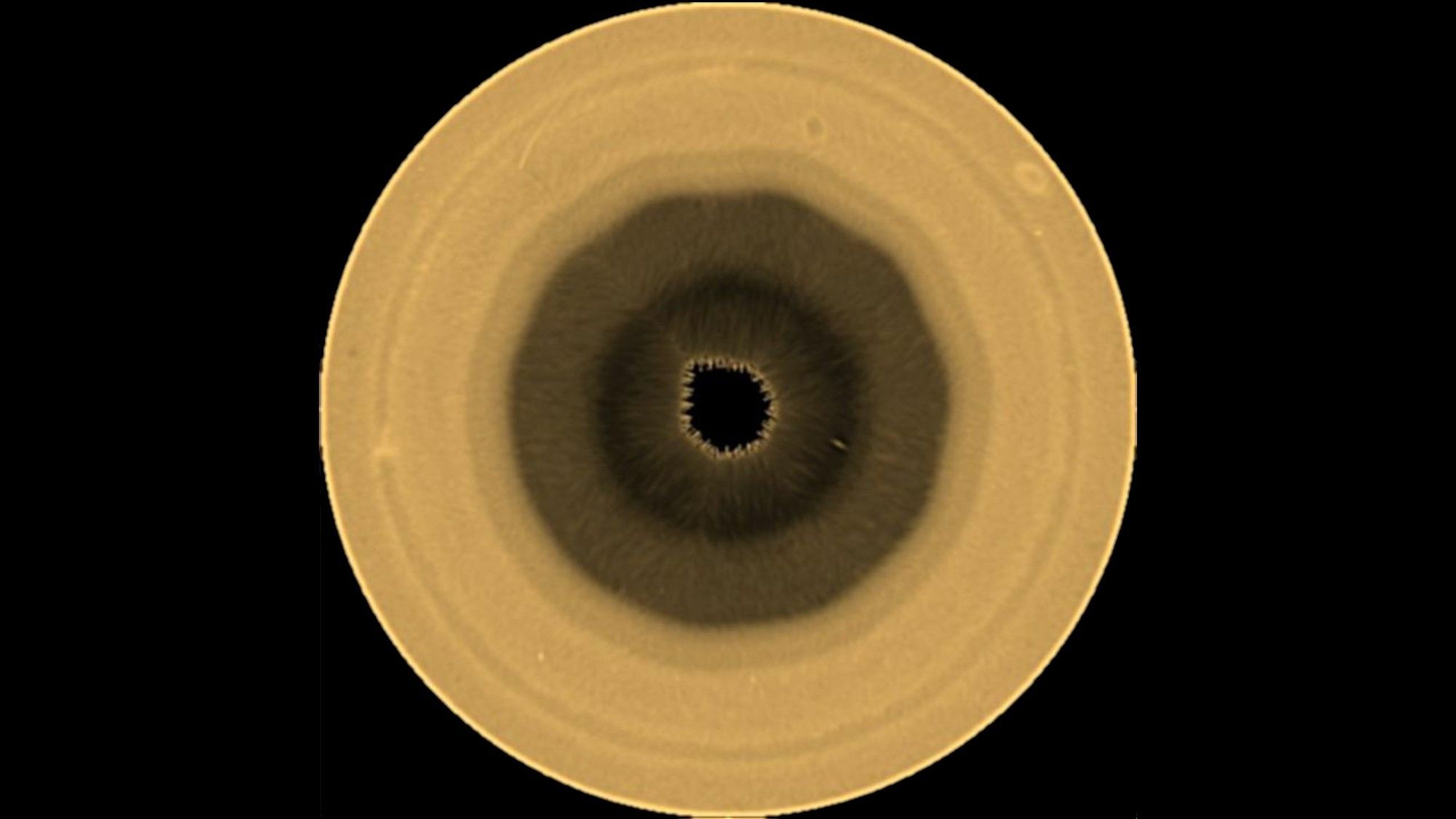
Recent observations from NASA’s Hubble Space Telescope show a large, evolving atmospheric wave surrounding the planet’s south pole. Researchers describe it as a decagon, and say it is the first large, regularly shaped jet pattern observed in Saturn’s southern hemisphere.
The feature was faintly visible in Hubble data from 2023. Ground-based observations helped reveal its development: planetary researcher Agustín Sánchez-Lavega and amateur astronomers Trevor Barry and Jean-Paul Oger identified an undulating band in images collected in 2024, while observations from 2025 showed a clearer decagonal structure.
The discovery was possible in part because Saturn’s tilt had kept its south pole turned away from Earth between 2012 and 2023. The Cassini spacecraft, which studied Saturn from 2004 to 2017, did not see the formation, suggesting that it had not yet emerged—or was not yet detectable—during that mission.
According to the supplied reports, the decagon lies within a powerful jet stream and extends through several atmospheric layers rather than existing only at the visible cloud tops. Its appearance also changes slightly at different wavelengths, which allows researchers to view different altitudes in Saturn’s atmosphere.
Space.com reports that the structure measures about 104,250 miles (167,820 kilometers) across, with sides roughly 10,425 miles (16,782 kilometers) long. It moves slowly, taking about 800 days to complete a rotation around Saturn, according to Sánchez-Lavega.
The southern feature is being compared with Saturn’s famous northern hexagon, a six-sided jet-stream pattern first identified in Voyager data and observed for more than 40 years. The two formations are not identical: the southern decagon is larger, appears to be strengthening, and varies in brightness across its sides and points.
Researchers do not yet know why the decagon formed so recently or whether it will settle into a stable pattern. Computer simulations of currents in shallow water, described by Space.com, suggest that a wave trapped by a curving atmospheric jet could produce the shape, but further observations and modeling are needed.
Scientists plan to continue monitoring the feature with Hubble and the James Webb Space Telescope to determine how it changes and how closely it resembles Saturn’s long-lasting northern hexagon.